Mitigating Fire Risks: QINFENG Machinery’s Solution for Recycling EPS Compactor
2024-01-10
Mitigating Fire Risks: QINFENG Machinery’s Solution for Recycling EPS Compactor
News cases
There was once a news report about a fire. Local fire officials said a fire broke out at a recycling center, sending smoke billowing and spreading for miles. The fire at the recycling center was so intense that thick smoke could be seen for miles. There were piles of discarded car parts, refrigerators and propane tanks that exploded and the smoke became thicker. Fortunately, the fire was brought under control in time, and no casualties were reported.
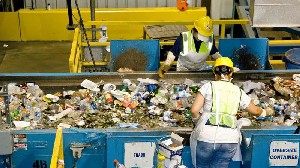
In this unexpected fire, besides some common flammable garbage, one of the most common items in the recycling bins at the center was EPS waste foam, which is, in fact, a highly flammable material. 98% of EPS foam waste is air, making it highly flammable. When flames are fueled by air, the fire can quickly spread and become difficult to control. Once a chain reaction ignites other combustible materials, it can lead to a massive fire, posing not only financial losses for the recycling center in terms of infrastructure but also threatening the lives of workers.
Therefore, preventing long-term exposure of such flammable materials to dry external environments is critical to reducing fire risk. In order to prevent EPS foam waste from accumulating in the warehouse and occupying inventory space. It will cause additional waste, abnormal circulation of goods, and increase management difficulty. It is necessary to use EPS foam plastic compactor to compress the waste in time and squeeze out the air.
Solution
QINFENG machinery provides a corresponding recycling solution for such issues. The EPS foam plastic compactor is an energy-efficient machine that can reduce the size of EPS materials, with a compression ratio of 1:30-1:50. The end product is EPS blocks with a density of up to 300 kg/m3. Customers can easily transport EPS materials to another recycling processing unit. In the recycling process, only electrical energy is required for efficient operation. By controlling the operation panel and adjusting settings, QINFENG machinery can provide customers with free debugging. Simply place the discarded EPS foam plastic into the crushing bin, and dense EPS blocks can be produced, reducing energy consumption and contributing to reducing the carbon footprint.



EPS Foam Compactor: A Key Technica…
In the modern logistics and warehousing industry, EPS (Expanded Polystyrene, commonly known as foam plastic) is widely used as cushioning packaging m…
Read moreHigh-Power Foam Densification Comp…
The Heavy Burden of Lightweight Materials Against the backdrop of intensifying global efforts to combat plastic pollution, the efficient recycling o…
Read moreThe Physical Recycling Pathway for…
The Heavy Burden of a Lightweight Material Polystyrene foam (including Expanded Polystyrene EPS and Extruded Polystyrene XPS), leveraging its lightw…
Read more