CreaStyr Initiative: EPS Compactor Technology Drives Plastic Circularity
2025-06-18
Industry Alliance Builds Recycling System
The CreaStyr project, launched by plastic packaging manufacturers’ alliance Elipso with support from the Electrical, Electronics, and Communication Industries Federation (Fieec), has signed a roadmap for polystyrene packaging recycling. Its core objective is to establish a comprehensive recycling system for expanded polystyrene (PSE) and extruded polystyrene (XPS) by January 1, 2025, covering industrial, commercial, and household packaging. A project spokesperson emphasized: “The focus is on strengthening collection and sorting systems, improving recycling rates and industry sustainability, quantifying environmental benefits, and raising public awareness.” Belgian specialist recycler Indaver recently joined the initiative.
Implementation Framework & Timeline
The project launch was accompanied by a detailed timeline:
Completion of collection network deployment across France’s 12 major regions by late 2023
Establishment of graded classification standards by 2024
Achievement of 100% EPS/XPS collection and recycling target by 2025
The key strategy is to divert materials from landfills or inefficient pyrolysis, instead enabling circular regeneration through mechanical compaction technology.
Technical Pathway Selection
For recycling foam materials like EPS/XPS/EPE/EPP, systematic planning must prioritize equipment selection. Feedback from Qinfeng Machinery’s French clients indicates local recyclers prefer cold-compaction technology—although its compression ratio is approximately 15%-20% lower than thermal alternatives, the chemically stable output blocks gain higher acceptance in downstream recycling markets.
Qinfeng CF-CP 380 EPS cold compactor, processes materials including paper, EPS (expanded polystyrene), EPE, PUR, and EVA waste, with a capacity of 150-200kg/h. It is equipped with four 2.2kw crusher motors and one 15kw screw motor. Through crushing and screw compaction of EPS waste, processed foam can be reduced to 1/50th of its original volume.

Closed-Loop Support Services
Additionally, beyond providing recycling solutions(EPS Compactor), we assist clients with relevant industry information and downstream buyer connections, striving to help achieve closed-loop recycling. This support model has been validated in Lyon pilot projects: one recycling center successfully connected with three plastic building material manufacturers through processed blocks, establishing a stable supply chain.
Technological Pivot for Industry Transformation
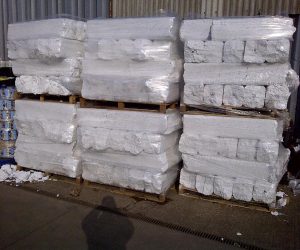
As the CreaStyr project advances, France’s polystyrene recycling landscape is undergoing structural change. Professional compaction equipment provides not just volume reduction solutions but also physical hubs connecting collection and regeneration. When loose foam is transformed into standardized blocks, these dense cubes become the most tangible units of circular economy—each compressed volume documenting the leap from linear consumption to closed-loop rebirth.


EPS Foam Compactor: A Key Technica…
In the modern logistics and warehousing industry, EPS (Expanded Polystyrene, commonly known as foam plastic) is widely used as cushioning packaging m…
Read moreHigh-Power Foam Densification Comp…
The Heavy Burden of Lightweight Materials Against the backdrop of intensifying global efforts to combat plastic pollution, the efficient recycling o…
Read moreThe Physical Recycling Pathway for…
The Heavy Burden of a Lightweight Material Polystyrene foam (including Expanded Polystyrene EPS and Extruded Polystyrene XPS), leveraging its lightw…
Read more